How to store your art between hangs
Rotating the art on your walls is one of the easiest ways to keep a space feeling fresh, and one of the most underrated. But the gap between taking something down and putting something else up is where damage quietly happens. Here is how to store flat wall art so it comes back out looking the same as it went in.
The basics: what flat art actually needs
Art stored flat or upright in stable conditions is art that lasts. The enemies are moisture, heat, pressure, and UV light, roughly in that order. A cool, dry interior space away from exterior walls, which can accumulate condensation, is ideal. Avoid attics, garages, and basements unless they are climate-controlled. A bedroom closet or interior wardrobe shelf is often the best option most people already have.
The other thing flat art needs is support. A poster or print left unsupported will curl, crease, or sag under its own weight over time. This applies whether it is stored flat or upright, and upright is generally better for anything rigid.
Posters and unframed prints
A rolled poster should be re-rolled loosely with the image facing inward, then slid back into its tube with the end caps on. Do not force it into a roll tighter than it wants to go. Tube creases are permanent. If the poster has been lying flat for a while, re-rolling gently around a wide cylinder, a second tube, a cardboard roll, or a mailing sleeve, will help it settle without stress.
For long-term storage, lay the tube horizontally rather than standing it upright. Weight bearing down on one end over months or years compresses the paper at that end and eventually shows.
Framed prints should be stored upright, not stacked flat. Stacking puts weight on the glass and the print, and a single slip can crack glass and crease paper in one go. Stand frames against a wall with padding between them. A folded towel or a cut piece of bubble wrap between each frame is enough.
Mounted canvas and gatorboard
Both are rigid, which makes them easier to store safely but more awkward to fit into a space.
Store canvas and gatorboard prints upright on their longest edge, not flat. Flat storage for rigid pieces invites warping over time, particularly in rooms where humidity fluctuates. If you are storing several pieces together, keep them separated with cardboard or foam sheets to prevent corners from digging into surfaces. Corners are almost always where damage starts.
Avoid leaning rigid pieces at a sharp angle for long periods. Near-vertical is fine. A forty-five degree lean puts ongoing stress on the piece, and if anything shifts, it falls.
Storing hanging hardware with the piece
The single best habit for anyone who rotates art is to store the hardware with the piece it belongs to. A sawtooth hanger with its screw, a set of adhesive strips with their remaining hold, a length of picture wire with its D-rings still attached: all of these should go into a small zip-lock bag taped to the back of the artwork or tucked into its tube or sleeve.
This solves the common frustration of finding a piece you want to rehang and spending twenty minutes looking for the right nail or the matching anchor. Everything is already there.
Adhesive strips that have been used once still have meaningful hold, but not the same grip as fresh ones. Write the date on the bag. After two or three rehangings with the same strips, replace them.
What long-term storage does to art
Paper-based prints stored rolled for years will want to stay rolled. The curl becomes part of the structure of the paper. When you eventually rehang, unroll it and let it rest flat under books for a full day rather than a few hours before framing or mounting.
Canvas can loosen slightly in low-humidity conditions. A fine misting of water on the back, not the front, then letting it dry while hanging, will typically re-tension it.
The most common long-term damage is to edges and corners, on pieces that were not separated or padded properly in storage. A ding in the corner of a canvas is difficult to fix. Cardboard corners, the same kind used to protect picture frames in transit, are cheap, available at framing and shipping stores, and will keep a piece in good condition for as long as you need.
Store it well, and rotating becomes something you actually look forward to.
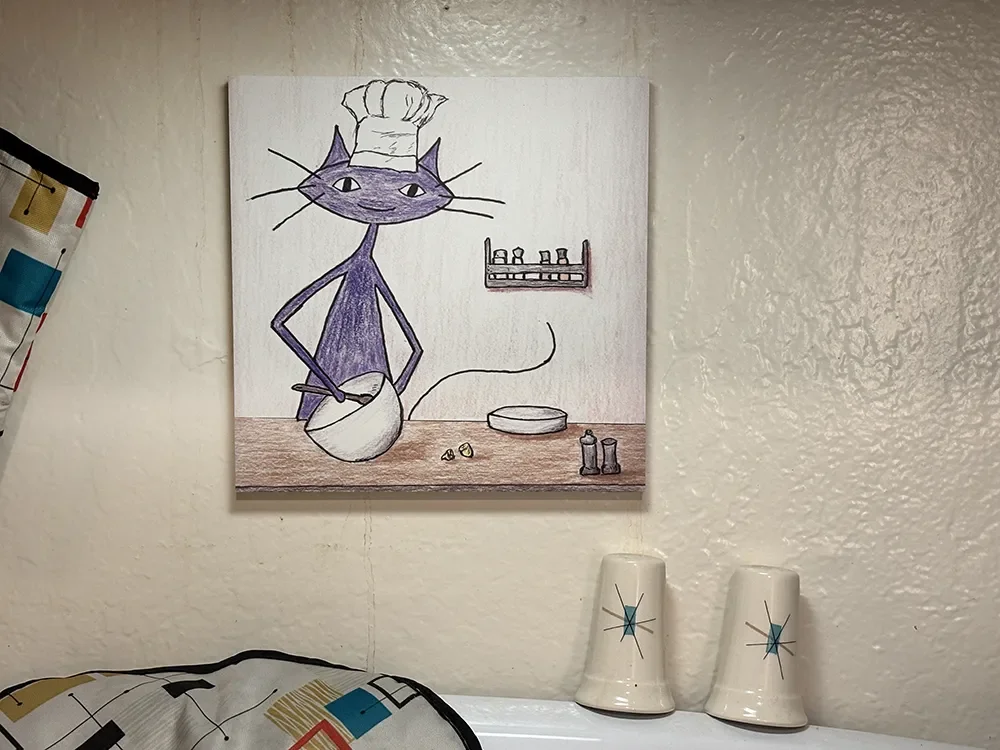
Apps and salads fly out the door when Purple Cat is at the pantry station. Facilitate your own mise en place with PC cheering you on. Perfect for every busy home kitchen.
Sizes
9" x 9"
11" x 11"
Archival substrate options
Paper
Mounted canvas
Black Gatorboard 3/16" panel