You Are Already a Collector
Quick question: Do you think of yourself as a collector? The word "collector" usually comes with a few very strict requirements. It conjures auction houses, provenance documents, and names that appear on museum donor walls. Most people hear it and assume it does not apply to them. But if you have ever bought a print because something about it stayed with you, you are already collecting. The question is whether you are doing it with intention.
What a personal collection actually is
It has been said that a collection is a point of view made visible over time. The prints you choose, the artists you return to, the way you arrange work across your walls: these accumulate into something that reflects how you see the world and what you find worth looking at. It is one of the genuinely personal touches in a home that can be full of manufactured objects.
This is also what distinguishes a collection from decoration. Decoration asks: does this work in the room? A collection asks: does this work matter to me? Both questions are legitimate, but only one of them compounds. Styles and seasons change; your decorations are taken out for display and put away again in turn. But a collection that is built with attention becomes more coherent, and more you, the longer you add to it.
The culture that makes this possible
The idea that an ordinary person might own original work, choose it themselves, and hang it in a home where they actually live is a product of the last century and, in its current form, largely of the last few decades. Print culture accelerated this. Editions, by definition, distribute access. A unique painting by a living artist might cost more than a car. An open-edition print of comparable quality, made by hand or printed with care, might cost less than dinner for two. The work is not a facsimile; it is the thing. The artist made it for multiples. The fact that others own a copy does not diminish what you own.
The collecting ecosystem now has real range, and that range is worth understanding.
The affordability spectrum
At the accessible end are open-edition prints, the kind sold by independent studios and smaller artists through their own storefronts or platforms like Etsy. These are typically printed in quantity with no stated limit. They are the most affordable entry point into collecting and also, often, the most direct relationship between buyer and maker. You are connecting with the person who created the work.
Limited editions occupy a middle ground. A print run of fifty or two hundred numbered works creates scarcity without pricing out most potential collectors. What distinguishes this type of print is that the artist was closely involved, if not totally responsible, for its production. An artist who ran the press and signed the work has made something more personal than one who has the printing done by a vendor.
At the upper end are artist's proofs, monoprints, and unique works on paper: pieces made by hand in the printmaking tradition, one at a time or in very small numbers, where the process itself is the point. These are the works you find at print fairs, in gallery back rooms, and occasionally at auction. They are priced accordingly, but they are also where the medium is at its most alive.
The most useful thing a new collector can do is decide which part of this spectrum to start in and then buy well within it rather than stretching toward the next tier before the current one feels natural.
Buying with intention
If you have only one guideline for your collecting, it should be this: buy work you would want to look at if it were never worth more than you paid for it. The walls of your home are the only museum you will spend every day inside. Fill them accordingly and with joy.
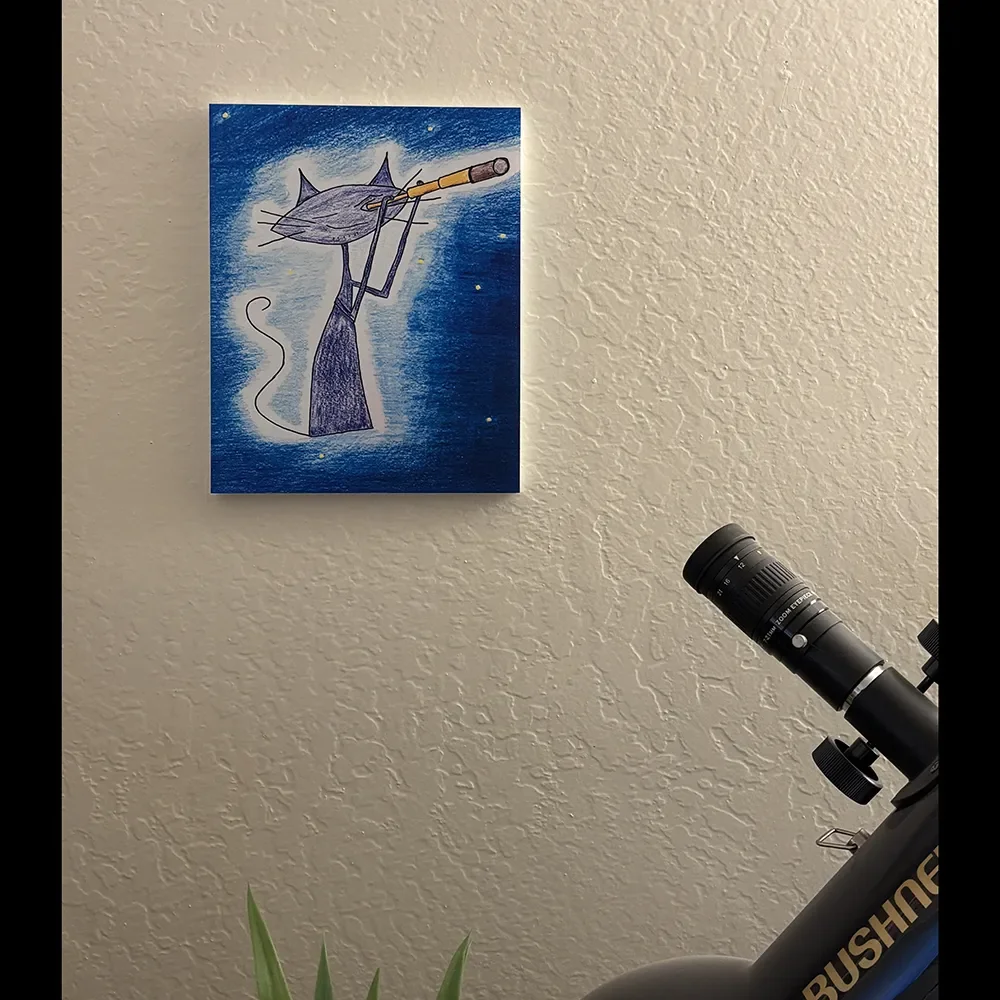
What’s out there? Purple Cat asks the eternal question and, with you alongside, scouts the local star group for a fabulous weekend destination! Inspiring and fun imagery adds adventure to any kid’s room or office.
Sizes
8" x 10"
11" x 14"
Archival substrate options
Paper
Black Gatorboard 3/16" panel
Canvas