
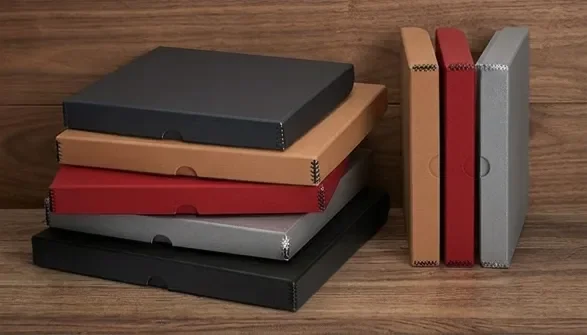
You Are Already a Collector
Do you think of yourself as a collector? Most people hear it and assume it does not apply to them. But if you have ever bought a print because something about it stayed with you, you are already collecting.
Quick question: Do you think of yourself as a collector? The word "collector" usually comes with a few very strict requirements. It conjures auction houses, provenance documents, and names that appear on museum donor walls. Most people hear it and assume it does not apply to them. But if you have ever bought a print because something about it stayed with you, you are already collecting. The question is whether you are doing it with intention.
What a personal collection actually is
It has been said that a collection is a point of view made visible over time. The prints you choose, the artists you return to, the way you arrange work across your walls: these accumulate into something that reflects how you see the world and what you find worth looking at. It is one of the genuinely personal touches in a home that can be full of manufactured objects.
This is also what distinguishes a collection from decoration. Decoration asks: does this work in the room? A collection asks: does this work matter to me? Both questions are legitimate, but only one of them compounds. Styles and seasons change; your decorations are taken out for display and put away again in turn. But a collection that is built with attention becomes more coherent, and more you, the longer you add to it.
The culture that makes this possible
The idea that an ordinary person might own original work, choose it themselves, and hang it in a home where they actually live is a product of the last century and, in its current form, largely of the last few decades. Print culture accelerated this. Editions, by definition, distribute access. A unique painting by a living artist might cost more than a car. An open-edition print of comparable quality, made by hand or printed with care, might cost less than dinner for two. The work is not a facsimile; it is the thing. The artist made it for multiples. The fact that others own a copy does not diminish what you own.
The collecting ecosystem now has real range, and that range is worth understanding.
The affordability spectrum
At the accessible end are open-edition prints, the kind sold by independent studios and smaller artists through their own storefronts or platforms like Etsy. These are typically printed in quantity with no stated limit. They are the most affordable entry point into collecting and also, often, the most direct relationship between buyer and maker. You are connecting with the person who created the work.
Limited editions occupy a middle ground. A print run of fifty or two hundred numbered works creates scarcity without pricing out most potential collectors. What distinguishes this type of print is that the artist was closely involved, if not totally responsible, for its production. An artist who ran the press and signed the work has made something more personal than one who has the printing done by a vendor.
At the upper end are artist's proofs, monoprints, and unique works on paper: pieces made by hand in the printmaking tradition, one at a time or in very small numbers, where the process itself is the point. These are the works you find at print fairs, in gallery back rooms, and occasionally at auction. They are priced accordingly, but they are also where the medium is at its most alive.
The most useful thing a new collector can do is decide which part of this spectrum to start in and then buy well within it rather than stretching toward the next tier before the current one feels natural.
Buying with intention
If you have only one guideline for your collecting, it should be this: buy work you would want to look at if it were never worth more than you paid for it. The walls of your home are the only museum you will spend every day inside. Fill them accordingly and with joy.
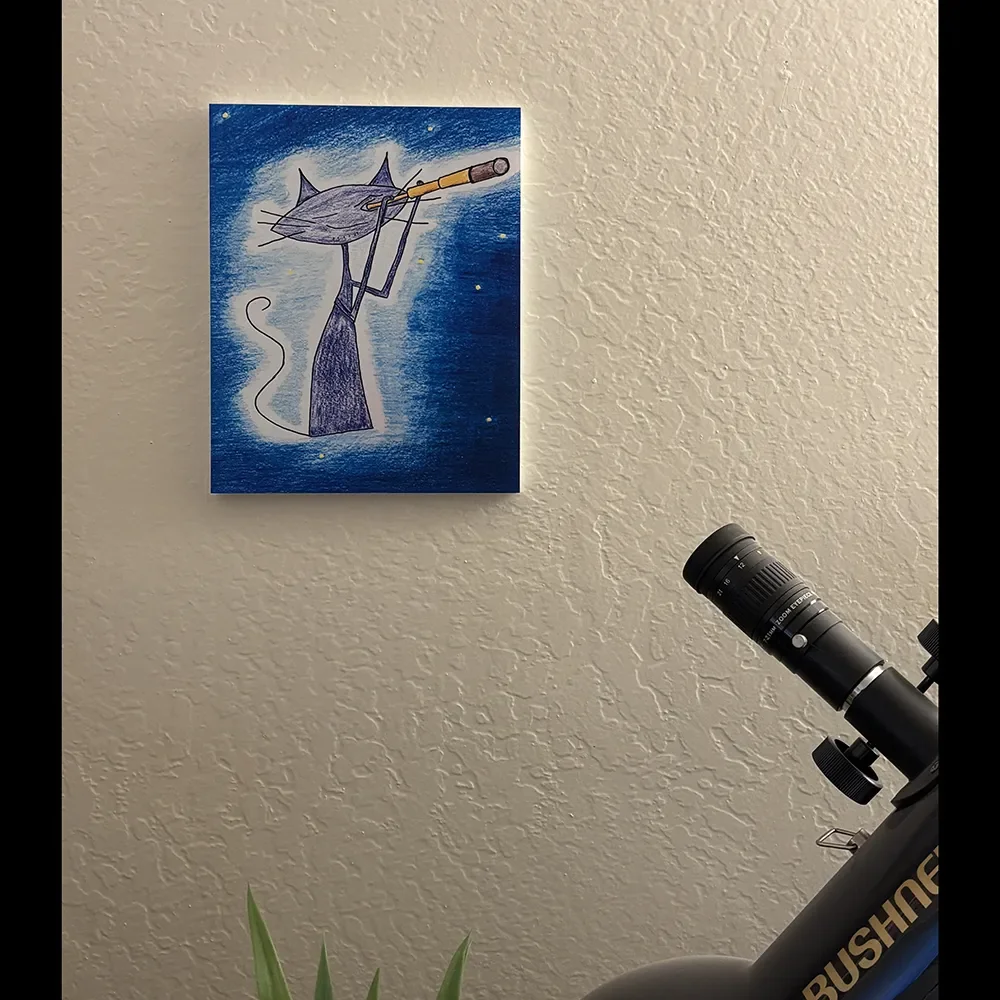
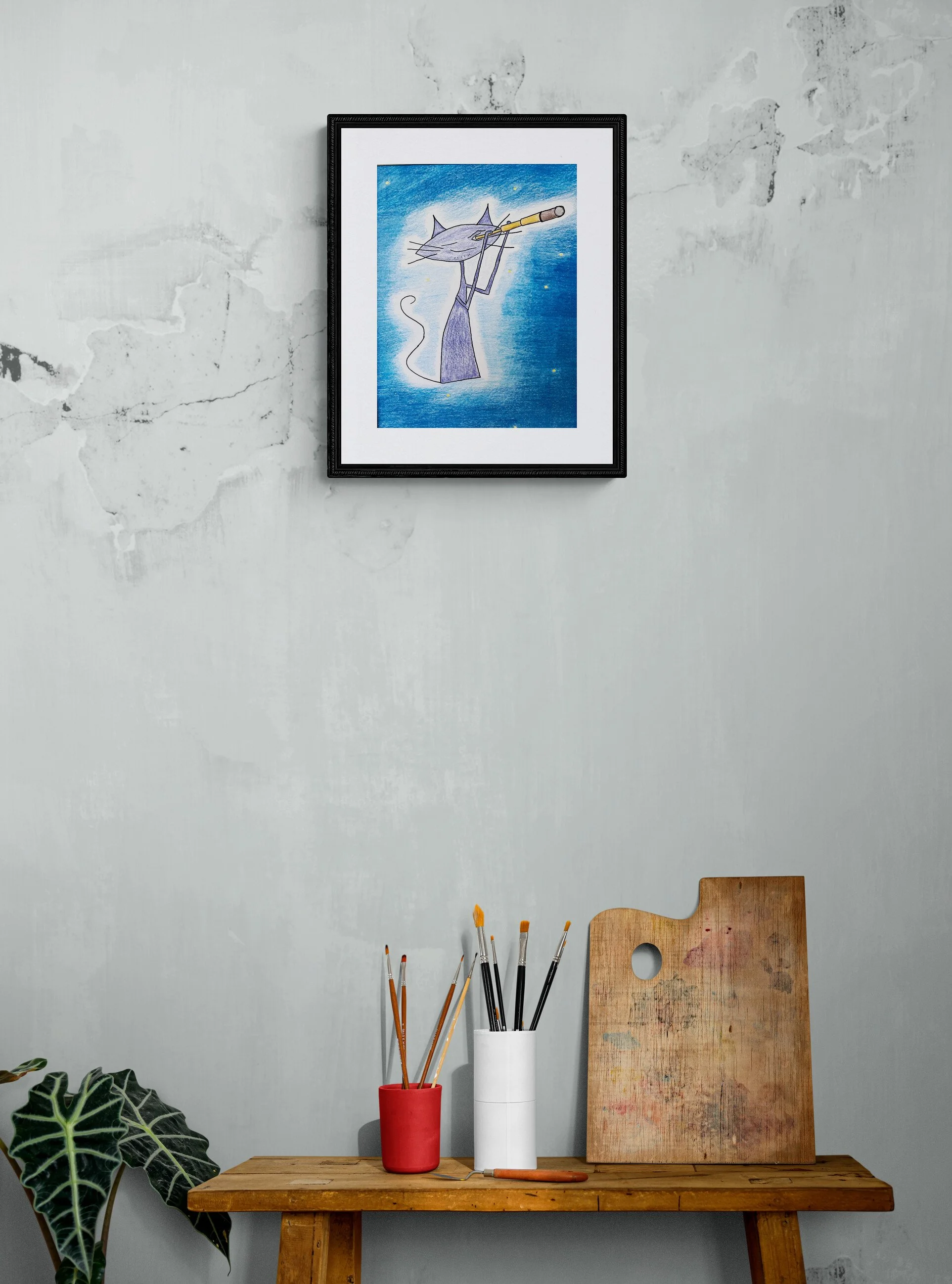
What’s out there? Purple Cat asks the eternal question and, with you alongside, scouts the local star group for a fabulous weekend destination! Inspiring and fun imagery adds adventure to any kid’s room or office.
Sizes
8" x 10"
11" x 14"
Archival substrate options
Paper
Black Gatorboard 3/16" panel
Canvas

How to store your art between hangs
Rotating the art on your walls is one of the easiest ways to keep a space feeling fresh, and one of the most underrated. But the gap between taking something down and putting something else up is where damage quietly happens. Here is how to store flat wall art so it comes back out looking the same as it went in.
The basics: what flat art actually needs
Art stored flat or upright in stable conditions is art that lasts. The enemies are moisture, heat, pressure, and UV light, roughly in that order. A cool, dry interior space away from exterior walls, which can accumulate condensation, is ideal. Avoid attics, garages, and basements unless they are climate-controlled. A bedroom closet or interior wardrobe shelf is often the best option most people already have.
The other thing flat art needs is support. A poster or print left unsupported will curl, crease, or sag under its own weight over time. This applies whether it is stored flat or upright, and upright is generally better for anything rigid.
Posters and unframed prints
A rolled poster should be re-rolled loosely with the image facing inward, then slid back into its tube with the end caps on. Do not force it into a roll tighter than it wants to go. Tube creases are permanent. If the poster has been lying flat for a while, re-rolling gently around a wide cylinder, a second tube, a cardboard roll, or a mailing sleeve, will help it settle without stress.
For long-term storage, lay the tube horizontally rather than standing it upright. Weight bearing down on one end over months or years compresses the paper at that end and eventually shows.
Framed prints should be stored upright, not stacked flat. Stacking puts weight on the glass and the print, and a single slip can crack glass and crease paper in one go. Stand frames against a wall with padding between them. A folded towel or a cut piece of bubble wrap between each frame is enough.
Mounted canvas and gatorboard
Both are rigid, which makes them easier to store safely but more awkward to fit into a space.
Store canvas and gatorboard prints upright on their longest edge, not flat. Flat storage for rigid pieces invites warping over time, particularly in rooms where humidity fluctuates. If you are storing several pieces together, keep them separated with cardboard or foam sheets to prevent corners from digging into surfaces. Corners are almost always where damage starts.
Avoid leaning rigid pieces at a sharp angle for long periods. Near-vertical is fine. A forty-five degree lean puts ongoing stress on the piece, and if anything shifts, it falls.
Storing hanging hardware with the piece
The single best habit for anyone who rotates art is to store the hardware with the piece it belongs to. A sawtooth hanger with its screw, a set of adhesive strips with their remaining hold, a length of picture wire with its D-rings still attached: all of these should go into a small zip-lock bag taped to the back of the artwork or tucked into its tube or sleeve.
This solves the common frustration of finding a piece you want to rehang and spending twenty minutes looking for the right nail or the matching anchor. Everything is already there.
Adhesive strips that have been used once still have meaningful hold, but not the same grip as fresh ones. Write the date on the bag. After two or three rehangings with the same strips, replace them.
What long-term storage does to art
Paper-based prints stored rolled for years will want to stay rolled. The curl becomes part of the structure of the paper. When you eventually rehang, unroll it and let it rest flat under books for a full day rather than a few hours before framing or mounting.
Canvas can loosen slightly in low-humidity conditions. A fine misting of water on the back, not the front, then letting it dry while hanging, will typically re-tension it.
The most common long-term damage is to edges and corners, on pieces that were not separated or padded properly in storage. A ding in the corner of a canvas is difficult to fix. Cardboard corners, the same kind used to protect picture frames in transit, are cheap, available at framing and shipping stores, and will keep a piece in good condition for as long as you need.
Store it well, and rotating becomes something you actually look forward to.
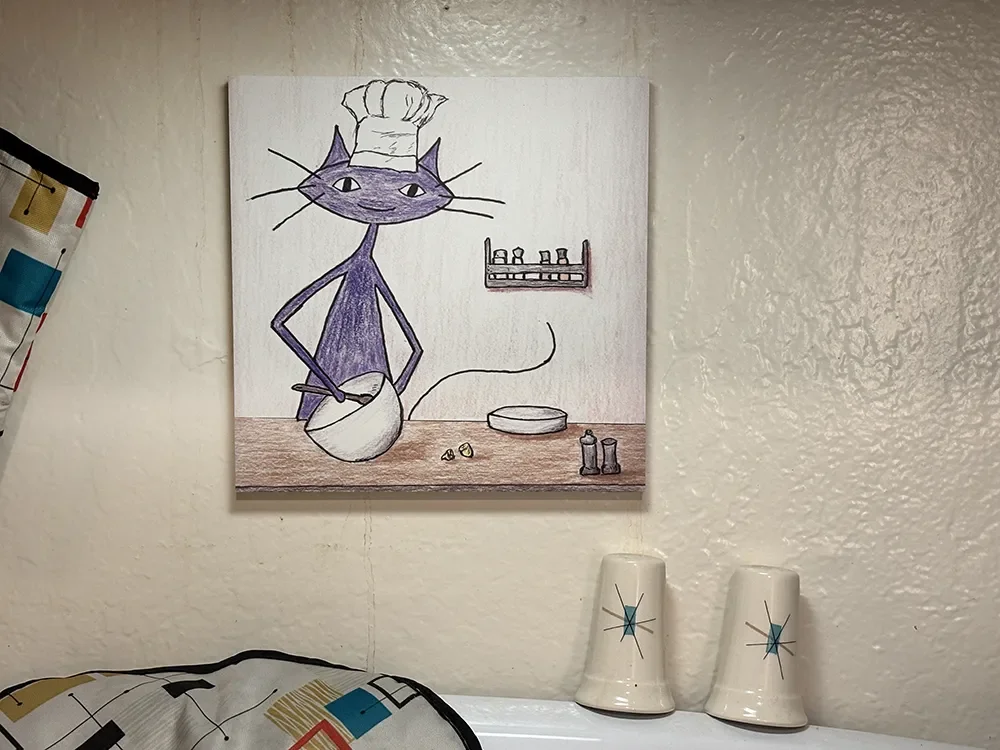
Apps and salads fly out the door when Purple Cat is at the pantry station. Facilitate your own mise en place with PC cheering you on. Perfect for every busy home kitchen.
Sizes
9" x 9"
11" x 11"
Archival substrate options
Paper
Mounted canvas
Black Gatorboard 3/16" panel
The no-panic guide to hanging art at home
We ship our prints without hanging hardware. This is intentional as hardware adds cost and weight to shipping, and most people already have what they need or can easily get it nearby. But if you're newer to hanging art, or you've just received your first poster or canvas and wondering where to start, this is the post for you.
There are three products in the shop: open-edition posters, mounted canvas prints, and gatorboard prints. Each one hangs differently.
Posters: frame them or float them
Posters ship rolled in a tube. Before you do anything else, unroll the poster and let it rest flat for a few hours—under a stack of books works well. This relaxes the curl and makes framing or mounting much easier.
The framed route
Framing is the most finished look and the most protective option. A standard frame with a backing board keeps the poster flat, protects it from humidity, and lets you move it without worrying about it. You'll need a frame sized to your poster (sizes are listed on each product page) and either a nail or adhesive picture-hanging strips rated for the frame's weight.
A single nail driven at a slight downward angle is all you need for most frames. If you'd rather avoid wall damage, good quality hanging strips hold reliably on most painted drywall and remove cleanly.
Frames: Stores like Target, IKEA, and most craft stores carry frames in standard sizes.
Hanging hardware: Home Depot, Lowe's, Ace Hardware, and Target carry nails and adhesive strips. Hanging strips are available in the home hardware section of many grocery stores and pharmacies, too.
The frameless route
Adhesive mounting corners or poster strips let you put a poster directly on the wall without a frame, presenting the artwork in a clean, simple, and easy-to-rearrange manner. Apply strips to each corner on the back of the poster, press firmly to the wall, and hold for thirty seconds per strip. Posters are light, so you'll be well within the weight rating on any standard strip.
This option is available at any office supply or home improvement store, and at most Target and Walmart locations.
Mounted canvas: what you'll need to add
Mounted canvas prints arrive ready to display, but without any hanging hardware. Happily, the options are straightforward and typically inexpensive.
The most common approach is a sawtooth hanger, then a single nail or screw in the wall. Drive the nail at a slight downward angle to keep the piece from sliding off. For heavier pieces, or if there's no wall stud where you want to hang, a drywall anchor (these expand inside the wall and grip the drywall without a stud) will do the job reliably.
You can also use D-rings and picture wire: measure the height of your canvas and mark 1/3 of the way down from the top on both sides. Place D-rings at those marks on the wooden frame (inside the frame, parallel to the wall) and screw them in securely, keeping both sides level. For larger pieces, hang from two attachment points for better stability.
A basic stud finder costs under fifteen dollars and is worth owning if you don't have one already. Sawtooth hangers, D-rings, picture wire, nails, screws, and wall anchors are all available at Home Depot, Lowe's, Ace Hardware, Target, and Walmart.
Gatorboard: lightweight and flexible
Gatorboard is a rigid foam board with a hard surface maiking it light, flat, and warp-resistant. Its weight makes adhesive strips the simplest and cleanest hanging option: no holes, no hardware, and they remove cleanly from most painted walls. Use the interlocking kind, not the single-tab kind as they are more secure for rigid pieces. Apply one pair to each top corner on the back of the piece, press firmly to the wall for thirty seconds, then remove it and let both sides cure for an hour before rehanging. That curing step matters as skipping it is why strips sometimes fail.
A single small finish nail or pushpin works just as well if you don't mind a small hole. Because gatorboard is so light, no anchor is needed.
One thing to watch for on larger pieces: gatorboard can bow slightly if hung from a single center point. For anything wider than eighteen inches, use two hanging points spaced evenly. Two strips, two nails, or one of each; each one will work.
Hanging strips are at virtually every Target, Walmart, CVS, Walgreens, Safeway, and home improvement store. Finish nails and pushpins can be found at any hardware or office supply store.
One last thing: the level
Every method in this post works better with a level. A small torpedo level costs a few dollars at any hardware store and saves you the five or ten minutes of stepping back, tilting your head, adjusting, and stepping back again that most of us have done more times than we'd like to admit.
If you don't have one, your phone does. iOS has a level built into the Measure app; Android has several free spirit level apps that work just as well.

Purple Cat knows where it’s at. You can practically hear the amber overtones of the sitar, complemented by the cool breezy beach-inspired sky. This cool-palette artwork makes a refreshing space in your music area, kid’s room, book nook, or any space that needs fresh air.
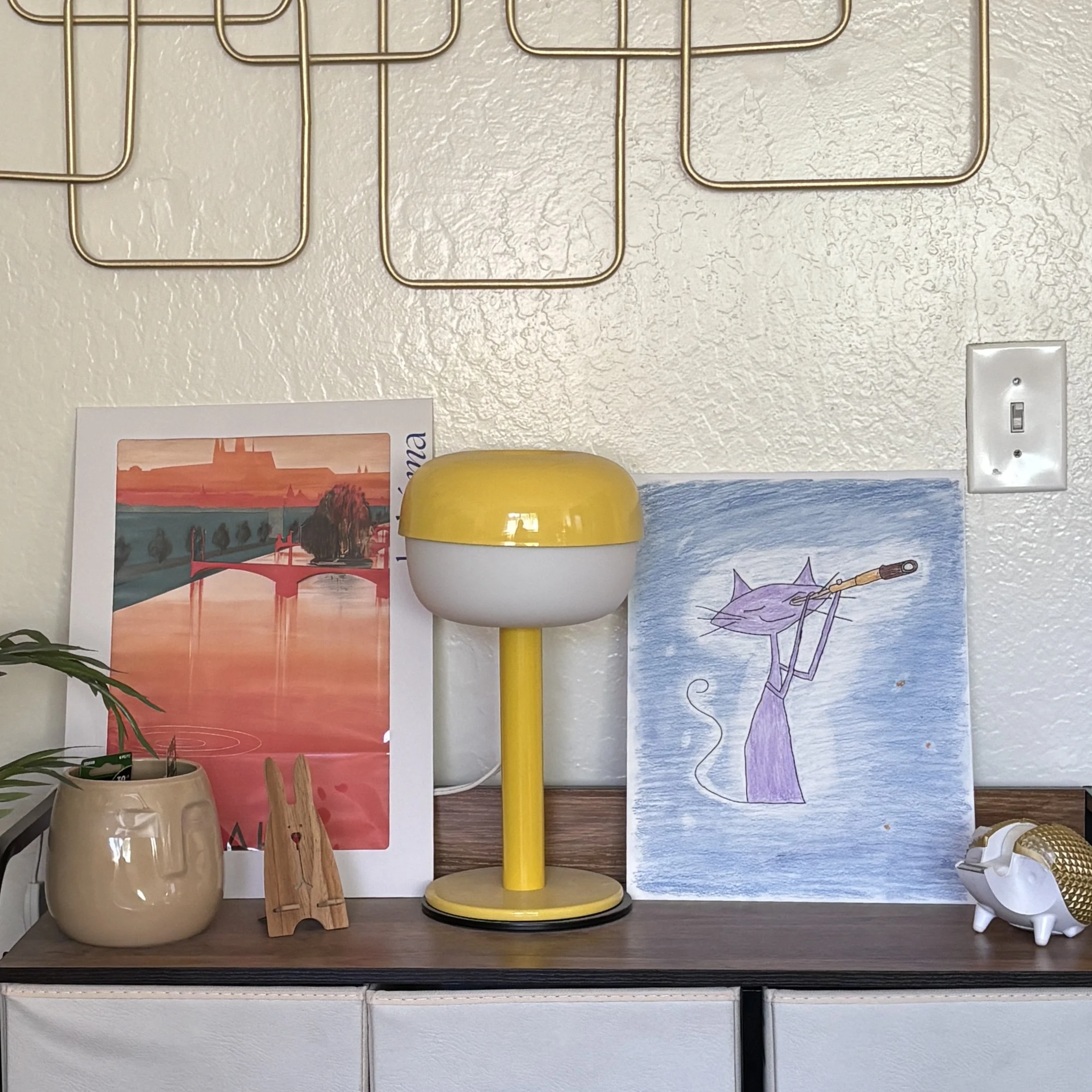
Purple does a lot of work—if you let it
Customer photo shows Purple Cat as a contrast with the reds and yellows, extending the room palette into a cool space.
While the science is still in development to quantify the phenomenon, anyone who has argued with their spouse about which of the 30 available shades of white to paint the living room with knows how important color choice is. The two rooms in your space you are most likely to spend long stretches of time in are your home office and your bedroom. Let’s discuss how artwork, especially work with large purple elements, fits in.
The home office: steady, not performing
The office asks a lot of purple. It needs to be present without being distracting, interesting enough to earn its place on the wall, and contained enough to let you work.
The undertone is where this lives or dies. A purple that pulls toward blue (violet, plum, dusk) reads as calm and focused. It anchors a wall without demanding attention. A purple that pulls toward red or magenta is energetic and a little restless. That choice is better suited to a wall you're not facing directly, something you catch when you stand up to stretch.
Think of what you want from a good colleague: present, reliable, not dominating every meeting. That's what a well-chosen purple piece does in an office. It's doing its thing and lets you get on with your day.
If your walls are a neutral—white, warm gray, greige—almost any purple will work. If you already have color on the walls, hold the piece up before you hang it. See what the two do together. If they fight, one of them needs to move.
The bedroom: the other end of the day
If the office asks purple to help you focus, the bedroom asks it to help you let go. Same color, completely different job.
Cool purples—lavender, dusty violet, the muted mauve that reads almost gray in low light—have a desaturated quality that works like a long exhale. On a white or soft sage wall, a piece in those tones won't spike your energy before bed. It'll be there, doing something beautiful, without making demands. That's exactly what you want at the end of a day full of decisions.
Warmer, more saturated purples tip the room somewhere else: luxurious, a little dramatic. That's not wrong; it just depends on what you want the room to feel like. Pair richer purples with brass frames and cream walls and the whole thing feels considered. Pair cooler purples with white frames and pale linen and the room settles.
One thing to avoid: art that creates visual clutter. Purple carries a lot of weight. If you're hanging a big, complex purple piece, keep the rest of the walls spare. More than any other room, the bedroom is allowed to ask very little of you.
The kid's room: both jobs at once
Children's bedrooms aren’t just bedrooms: they’re play and (home)work spaces, too. A kid lives the rest/work tension in a single room. The art has to navigate it too.
Purple helps here because it's one of the few colors that can read as both energizing and soothing, depending on value and saturation. Bright, warm purples (grape, fuchsia-adjacent, a punchy lilac) carry the energy a kid's room needs during the day. Softer, hazier purples can hold the room gently at night without making the space feel babyish.
A common misstep is overdoing the layering: purple art plus a purple bedspread plus purple curtains, and suddenly the room has no air. Let the art do the heavy lifting. Keep bedding simple by leaning toward whites, perhaps oatmeal or a soft complementary color like pale yellow or warm green. The art reads as deliberate and the room can breathe easily.
Keep in mind for older kids: darker purples (aubergine, deep violet) can skew more grown-up, which might be exactly what a ten-year-old wants. Ask them.
The through line
What connects these three rooms isn't the color: it's the hours. You spend more time in your office and your bedroom than almost anywhere else at home. That time accumulates. The art on those walls accumulates with it, becoming part of the backdrop of your days and nights in a way a piece in the hallway simply doesn't.
Purple rewards sustained attention, shifting in different light, changing its character depending on what surrounds it. Choose the version that matches what the room needs to do, and then let it work.
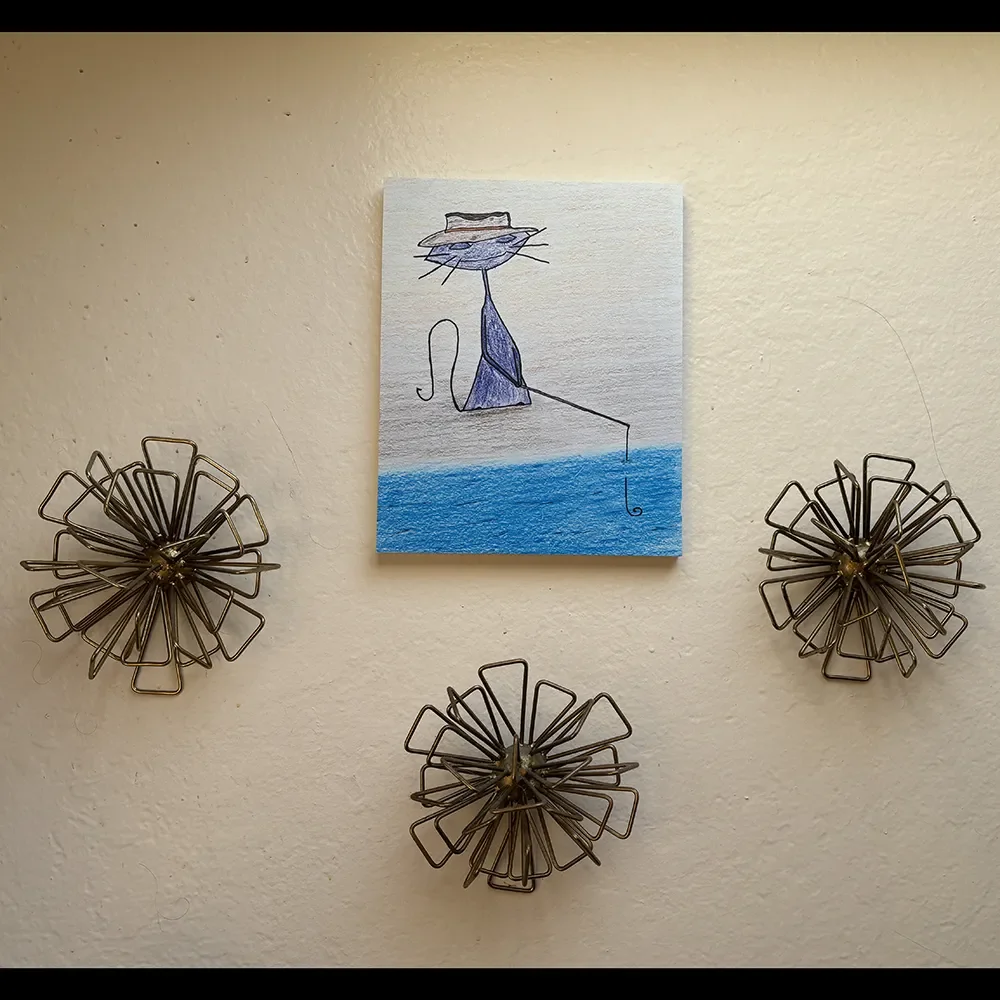
De-stress as you sit alongside Purple Cat next to the creek, cool breeze on your face. The fishing pole is just for show - you’re here for the power naps. Relaxing and calming for your bathroom or kid’s room.
Sizes
8" x 10"
11" x 14"
Archival substrate options
Paper
Black Gatorboard 3/16" panel
Canvas
About me and Purple Cat…
This day was inevitable — Purple Cat just would not leave me alone, so I'm building this place to share what PC brings to me with all you wonderful people.
This day was inevitable — Purple Cat just would not leave me alone, so I’m building this place to share what PC brings to me with all you wonderful people. It has been a decade since I first drew the football-and-triangle-shaped critter and it’s the one I come back to most when I have a story I want to tell. Astronomer, sea captain, chef, surfer, dumpster diver, petsitter … On my drawing board, this cat does it all.
I recently finished an abstract painting series (curated views to come) for which I thought a great deal about the general state of the world and how humanity as a whole might come out of our current situation in one piece. Surprisingly, I emerged with more hope than when I went in. I don’t want to sound facile — things are stark in many places. We who want change can only do what we can. But we must do it, even if it is as simple as a cat reaching for the stars.
You can’t change the world. But the world changes every day.
And I've come to believe that's not a reason for despair — it's the whole opening. Change doesn't wait for permission or perfect conditions. It happens in small rooms, in small acts, in the stubborn decision to keep making things that are honest and hopeful. That's what Purple Cat keeps teaching me, ten years in. Show up. Be curious. Reach anyway.
So that's what this place is. A sketchbook made public. A little proof that one absurd, football-shaped cat can carry a lot of meaning — if you let it.
Welcome. I'm glad you're here.
Get Here First
New prints, pins, and behind-the-scenes moments from the studio — straight to your inbox before anyone else sees them. No noise, just the good stuff.